
2027 Asia Pacific Coercive Control & Children Conference: Call for Presenters
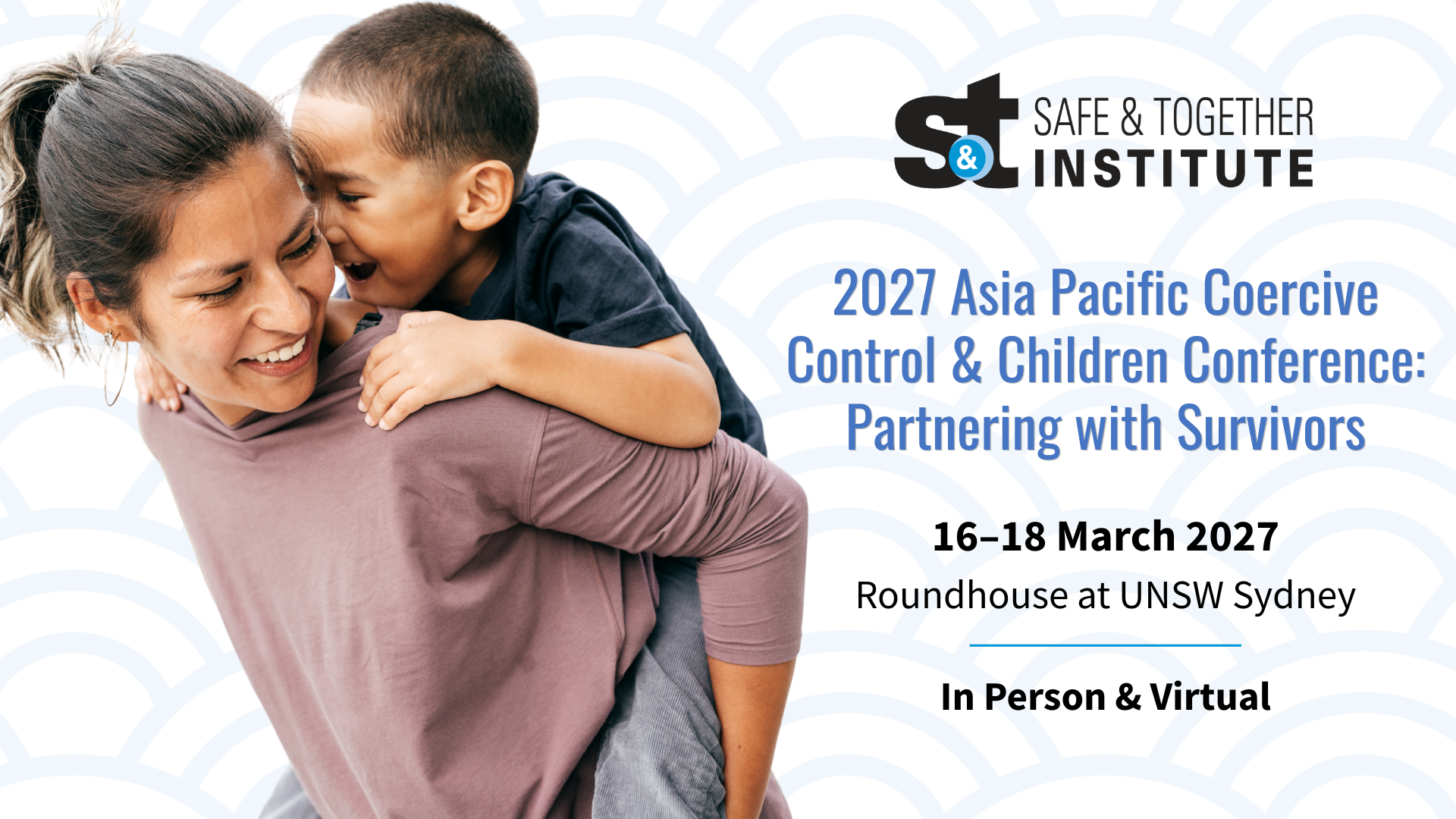
Our 2027 Asia Pacific Coercive Control & Children Conference is officially scheduled for 16–18 March 2027 at Roundhouse on the University of New South Wales (UNSW) campus in Sydney’s Eastern Suburbs.
In 2027, we’re turning the spotlight on partnering with survivors, one of the three foundational principles of the Safe & Together Model. At its core, partnering is a human-rights stance: it treats the survivor as a person owed dignity, autonomy, and respect, and as the most knowledgeable source on the perpetrator’s behaviour and its impact on her children. It means starting from her strengths rather than her deficits. We’re not here to rescue someone who is broken, but to partner with someone already protecting her children under constraint.
We are now seeking proposals for workshops and presentations for the 2027 conference across the following four tracks:
Partnering in Child Protection: Content on what partnering looks like inside statutory power and risk: documenting the perpetrator’s pattern of coercive control instead of defaulting to a survivor’s “non-compliance” and making her protective efforts visible in case files, assessments, and case planning.
Partnering with First Nations and Cultural Communities: Content centring the leadership and knowledge of First Nations, Torres Strait Islander, Pasifika, Māori, and other communities in defining partnering on their own terms and treating cultural and family ties as protective capacity, not risk.
Family Law: Partnering Beyond “High Conflict”: Content on where mutualised “high-conflict” framing and court process obscure a perpetrator’s coercive control and its impact on children and what pattern-based, defensible reports and assessments look like instead.
Health Responses: Partnering Without Pathologising: Content on how clinicians and health system leaders can avoid mislabelling a survivor’s distress as pathology or “treatment resistance” and instead correctly attribute it to the perpetrator’s coercive control.
Partnering is operationalised through the Model’s six specific steps: Affirm, Ask, Assess, Validate, Collaboratively Plan, and Document (watch this video for the definitions of each step and listen to this episode of Partnered with a Survivor for additional learning). We invite presenters to use this shared language in shaping their session, regardless of which track it sits in.
A strong proposal shows partnering as observable practice or system design, anchored in the perpetrator’s pattern of coercive control, and makes the survivor’s protective efforts and the children’s experience visible. We’re less interested in the language of support in the abstract and more interested in what professionals and systems actually do and how we know it’s working. Every proposal should move from problem to practice. It’s not enough to name where a system, service, or profession falls short. A strong proposal names the gap and shows how the Safe & Together Model—through its principles, critical components, and partnering practice—closes it. Critique is a starting point, not a session.
We strongly encourage survivor presenters or joint survivor/agency sessions. We’re especially interested in how the Model’s principle of partnering and its six steps align with different communities and contexts (e.g., the needs of survivors with significant health needs).
-
Deadline for Proposal Submission: 14 September 2026
Notice of Acceptance: 6 November 2026
Conference: 16–18 March 2027
-
45–60 minutes, with 5–10 minutes for Q&A
-
Child welfare caseworkers, team leaders, supervisors, managers/administrators
Child welfare attorneys
Domestic violence advocates, counselors, administrators
Policymakers
Researchers
Family court professionals
First Nations organisations
Home visitors
Mental health and substance abuse professionals
Fatherhood program staff
Perpetrator behaviour change intervention providers
-
Lived experience and cultural knowledge are forms of professional expertise, and we’re actively seeking presenters who hold them. We especially welcome proposals from survivors; First Nations, Torres Strait Islander, Pasifika, Māori, and other cultural and community experts; and from those who carry both lived experience and practice expertise.
You do not need a conventional practitioner title to present. We’re looking for a proposal that connects your expertise to observable practice or system design through the Safe & Together Model. Strong proposals from survivor and cultural experts do one or more of the following:
Show what partnering looks and feels like from the survivor’s or community’s vantage point: where systems partnered well, where they didn’t, and what the difference was in concrete terms for a survivor and their children.
Demonstrate how cultural knowledge, kinship, and community ties operate as protective capacity and how the Model can be practiced in ways that treat them as strengths rather than risk.
Translate lived or cultural expertise into concrete guidance practitioners and systems can adopt: the “do this instead” that changes a case file, an assessment, a court report, or a clinical judgement.
Name where the Model itself must stretch, be applied with cultural humility, or be led by community on its own terms, and propose how.
If you hold this expertise but have had limited formal Safe & Together Model training, we still want to hear from you. Tell us how your expertise aligns with, strengthens, or challenges the Model’s principles and partnering practice, and we will work with you on framing (see Submission Criteria section).
-
Presenters should either (a) have had some Safe & Together Model training and implemented its principles, critical components, and/or practice in their personal, agency, or community practice or policy or (b) hold survivor lived expertise or cultural/community expertise that they can connect to the Model’s principles and partnering practice. If you are in the second group and would like support with translating your expertise into the Model’s language, please mention this in your proposal. We will pair you with a member of the Institute to develop the framing while keeping your voice and authorship central.
Collaborative presentations are welcome. Please limit the number of presenters to two (2).
Presenters will be asked to submit a brief biography, an explanation of their experience using the Safe & Together Model (including any training received), and a press photo or headshot.
All submissions are expected to include:
The Safe & Together Model principles and/or components the topic addresses, including how the session engages with partnering and the perpetrator’s pattern of coercive control
Practice- or systems-level behavioural examples aligned with the Model’s Six Steps of Partnering
The specific principle, critical component, or partnering step that corrects any problems stated and describe what better practice looks like in observable terms
How this topic supports practitioners and systems in the relevant track (child protection, First Nations and cultural communities, family law, or health)
How the application of partnering improves the effectiveness of practice while keeping it child-centred
A practical takeaway attendees can put into practice immediately after the session
Lessons learned and/or formal evaluation data, where available
Submissions that only diagnose shortfalls without offering a Model-based path forward will be asked to revise.
-
Proposals will be reviewed based on the following points:
Clarity of understanding of the Safe & Together Model and its version of partnering as a practice skill and system-design principle, not a disposition
Anchoring in the perpetrator’s pattern of coercive control, with the survivor’s protective efforts and the children’s experience made visible
Creative or innovative implementation of the Safe & Together Model OR well-established implementation of the Safe & Together Model, backed by a demonstrated track record
A clear, practical takeaway attendees can use immediately
Sustainability and fidelity implementation strategies
Use of Safe & Together to improve cross-system collaboration
Impact of Safe & Together on families and service delivery, supported by qualitative and/or quantitative data where available
Movement from problem to solution, with a concrete “do this instead” rather than diagnosis alone
Inclusion of survivor and cultural expertise as legitimate evidence and authority, with partnering shown from the survivor’s or community’s vantage where relevant
-
Complimentary registration
Access to the VIP Happy Hour
Professional exposure
Custom marketing materials to share on your social media
On-demand access to all conference sessions
-
By submitting a proposal, potential presenters understand and agree to the following:
If selected to present, presenters must confirm their attendance and willingness to present one (1) week after notice of acceptance.
All presenters must register for the event online prior to the registration deadline.
Presenters are responsible for submitting any handouts or materials for participants three (3) weeks prior to the event.
Presenters agree to allow the Safe & Together Institute to put presenter biographies on the conference registration website.
Presenters agree to allow the Safe & Together Institute to broadcast and record their session for online viewers to access during and after the conference.
Presenters agree to allow the Safe & Together Institute to provide feedback or request changes to any presentation proposal submission, including but not limited to: change in timeframe of presentation, addition of or removal of materials that do not fit within the principles of the Safe & Together Model, or change in schedule.
If selected, registration fees will be waived for up to two (2) of your workshop presenters.
Applications are closed for the 2027 Asia Pacific Coercive Control & Children Conference. Thank you to all who submitted.