
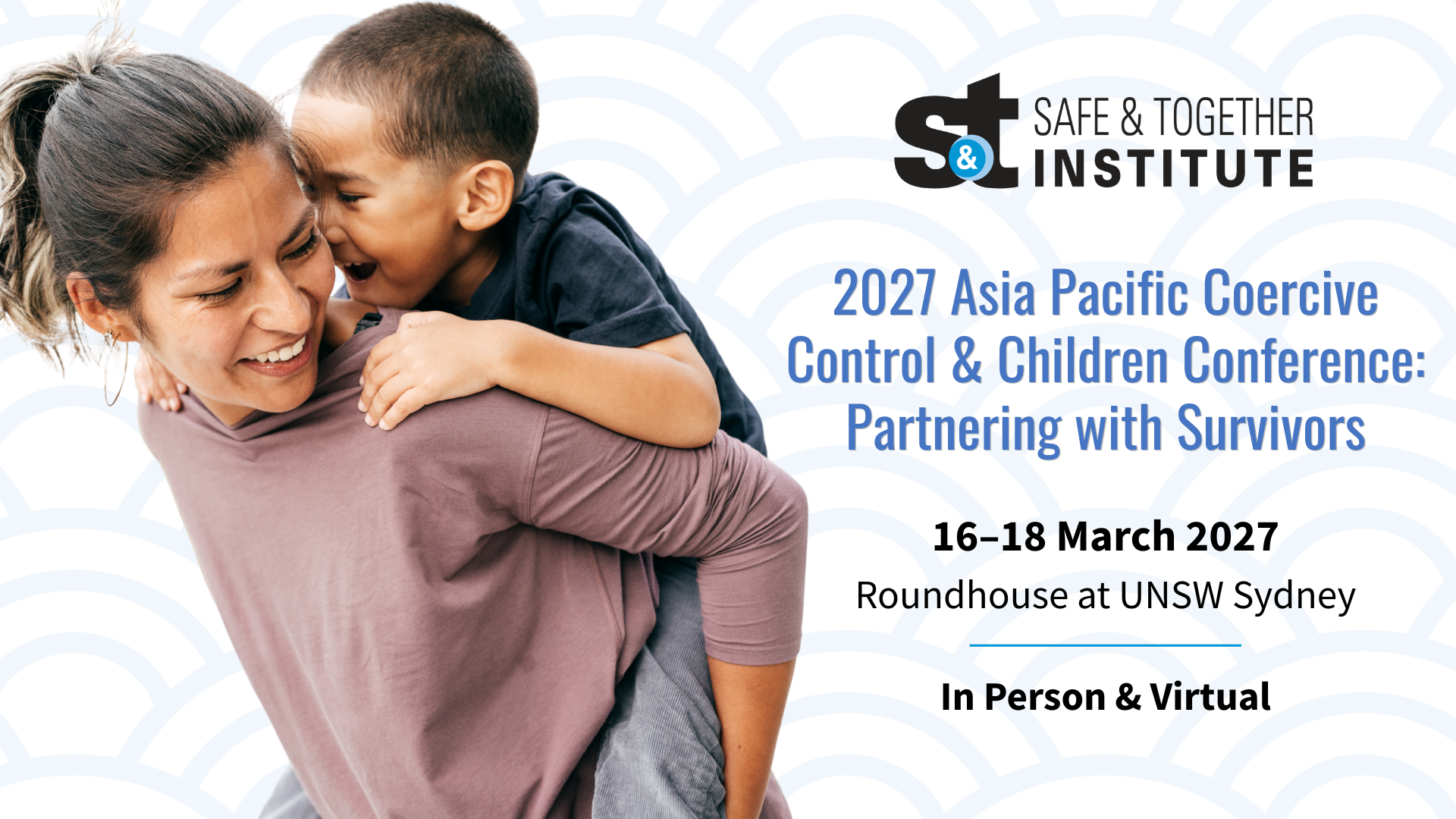
Registration is now open for the 2027 Asia Pacific Coercive Control & Children Conference, taking place 16–18 March 2027 at the Roundhouse on the University of New South Wales campus in Sydney’s Eastern Suburbs. Register by 31 December 2026 to lock in early-bird pricing.
Across three days, practitioners, researchers, policymakers, and advocates from across the region will come together to sharpen their domestic violence–informed practice, compare notes on what’s actually working in their systems, and build the kind of professional relationships that outlast the conference itself.
In 2027, we’re turning the spotlight on partnering with survivors, one of the three foundational principles of the Safe & Together Model. At its core, partnering is a human-rights stance: it treats the survivor as a person owed dignity, autonomy, and respect, and as the most knowledgeable source on the perpetrator’s behaviour and its impact on her children. It means starting from her strengths rather than her deficits. We’re not here to rescue someone who is broken, but to partner with someone already protecting her children under constraint.
Partnering isn’t a softer, add-on relational step. It’s how each sector gets better at its own mission, and it can’t happen without a clear view of the perpetrator’s pattern of coercive control and the harm it causes children. This year’s program moves past general awareness into the specific skills, documentation practices, and system changes that make partnering real, observable, and measurable.
If 2026 sharpened how we hold perpetrators to account, 2027 takes on the other half of the pattern. It’s not a repeat—it’s the next step, moving from “how I partner in a case” to “how a system is built to partner,” with new skills, tools, and measures you haven’t seen from us before.
Session & Workshop Tracks
Whether you attend in-person or virtually, sessions and workshops will run across four tracks:
Partnering in Child Protection: This track explores what partnering looks like inside statutory power and risk: documenting the perpetrator’s pattern of coercive control instead of defaulting to a survivor’s “non-compliance” and making her protective efforts visible in case files and assessments. Sessions draw on practice from statutory child protection settings, work with multicultural and faith communities, and responses when the person using coercive control is an adolescent. It’s the practice that moves the numbers agencies are judged on: fewer removals, fewer re-reports, and decisions that hold up, keeping children safe and connected to the parent protecting them.
Partnering with First Nations and Cultural Communities: This track centres the leadership and knowledge of First Nations, Torres Strait Islander, Pasifika, Māori, and other communities in defining partnering on their own terms, treating cultural and family ties as protective capacity, not risk. Sessions bring culturally grounded practice with First Nations women and communities across Australia, including workforce development delivered directly in community. Done well, it reduces culturally driven removals and keeps children connected to kin and culture rather than separated by coercive control or by the systems responding to it.
Family Law: Partnering Beyond “High Conflict”: This track looks at where mutualised “high-conflict” framing and court process obscure a perpetrator’s coercive control and its impact on children and what pattern-based, defensible reports look like instead. The payoff: orders grounded in actual pattern rather than competing claims, fewer returns to court, and outcomes that put children’s safety first.
Health Responses: Partnering Without Pathologising: This track examines how clinicians can avoid mislabelling a survivor’s distress as pathology or “treatment resistance” and instead attribute it correctly to the perpetrator’s coercive control. Sessions include how neurodivergent survivors’ protective strategies—masking distress, adapting routines—are often misread as inconsistency or overprotection, alongside firsthand accounts of what health systems get wrong. Accurate assessment and treatment depend on it, and it’s what keeps a health response from missing the risk his behaviour poses to the children in the family.
Across every track, the bottom line is the same: partnering with fidelity means better outcomes for survivors and children, by keeping professional attention and system resources trained on the perpetrator’s behaviour instead of misdirected onto the survivor.
Every session will leave you with something concrete: assessment tools, documentation practices, and system-design approaches you can apply immediately, whether you’re new to the Model or years into implementing it.
Interested in presenting? Click here to submit a proposal by 14 September.
Keynote from David Mandel
David Mandel, founder and CEO of the Safe & Together Institute, will open the conference with a keynote reframing partnering as radical respect—a demanding, measurable discipline, and the other half of a perpetrator-pattern approach rather than an addition to it. His challenge to the room: stop fitting diverse survivors into standardised solutions, start building systems around the strengths they already hold, and prove partnering is working by design, not by accident.
Registration
Register now to secure your place and take advantage of early-bird pricing, available until 31 December 2026. We look forward to seeing you.